
How to Build a Sustainable Walking Routine After a Break
Choose a short walk you can comfortably repeat, give it a place in your week, and increase it only when that starting point feels manageable.
That is how to build a sustainable walking routine after a break. Your old distance can wait. The more useful question is: what could you do this week without making next week harder?
A familiar route, comfortable shoes and a realistic backup plan are enough to begin. You do not need a fitness watch, a daily streak or an ambitious step target.
Find a baseline you can repeat
A break caused by busy weeks calls for a different approach from a break caused by an injury or illness. If a health problem, surgery or ongoing symptoms stopped you walking, ask your GP or treating health professional about returning. This guide is general information, rather than a rehabilitation plan.
For an otherwise well adult restarting after time away, a short, easy walk is a practical starting experiment. Try a familiar, mostly level route with a simple way to turn back. Five or ten minutes might be manageable for some people; others will need less. Those numbers are examples, not a minimum requirement.
Begin gently rather than rushing to your old pace. Notice how you feel during the walk, later that day and the next morning. Could you fit it into another ordinary day? Did it leave you unusually tired, sore or reluctant to go again? Use those observations to choose your next walk.

Put the starting point in your diary
Choose a few realistic opportunities rather than promising to walk every day immediately. For example: after breakfast on Monday and Thursday, then a weekend loop if it suits. Leave enough flexibility to repeat or reduce the plan when needed.
Write down the route and approximate time. “Walk to the nearby reserve and back after breakfast” is easier to act on than “get fitter”. Keep the first route simple enough that you do not need to organise transport, pack equipment or find a spare hour.
Increase gradually, with room to repeat
Once your starting walk feels comfortable across several outings, make one small change. You might extend one walk by a few minutes, add another short outing, or later include a brief quicker section. Avoid changing distance, pace and hills together: it becomes harder to tell which change was too much.
There is no need to increase every week. Repeating the same manageable walk is a useful part of building a routine. Healthdirect recommends starting slowly and building up gradually when you have not been doing much activity.[1]
As fitness returns, you can gradually work towards a more purposeful pace. Healthdirect describes moderate-paced walking as faster than your usual walking pace while still allowing you to talk.[2] An easy restart does not have to reach that intensity immediately.
| What you notice | A practical adjustment |
|---|---|
| The route feels comfortable and fits your day. | Repeat it, or make one small increase if you feel ready. |
| The walk is manageable, but your week is busy. | Keep the same duration. Protect the habit before adding more. |
| You feel unusually drained afterwards. | Allow recovery and reduce the next walk. Seek advice if this persists. |
| You develop pain, swelling or a limp. | Stop and seek appropriate advice rather than increasing the walk. |
Think of national activity guidance as a longer-term direction. Australia’s recommendations for adults aged 18–64 include 30 minutes or more of moderate- to vigorous-intensity activity on most days, alongside strength work, functional activities and lighter daily movement.[3] That is not a requirement for your first walk back, and walking does not need to carry your whole activity plan.
Make footwear and comfort part of the plan
Start with shoes that fit comfortably and feel secure. Check for rubbing, toes pressing against the front, a slipping heel or a worn, slippery sole. Healthdirect advises comfortable, well-fitting footwear for walking.[2] An expensive new pair is not automatically necessary.
Test unfamiliar shoes on a short outing near home before taking them on a longer route. Adjust socks and lacing if they rub, but do not keep walking through developing blisters or foot pain. Persistent problems are worth discussing with a podiatrist or another suitable health professional.
Keep your shoulders relaxed and use a natural stride. You do not need to force long steps or copy a power-walking technique. Choose a surface and pace that let you move comfortably.

Choose a route for the day you actually have
A pleasant weekend trail may be impractical on a workday. Have one dependable local option: a nearby footpath loop, a level park circuit or a convenient indoor route. Consider crossings, uneven surfaces, lighting and places to pause, rather than judging a route only by its distance.
Australian conditions can change the plan. On a hot day, choose a cooler time or an appropriate indoor alternative. Check local weather and air-quality advice when conditions are poor, and take water suited to the conditions and length of your outing.
Check UV as well as temperature. Cancer Council recommends sun protection when the UV Index is 3 or above, including clothing, a hat, shade, sunglasses and broad-spectrum, water-resistant SPF50 or higher sunscreen.[4] A cool or cloudy day can still call for protection.
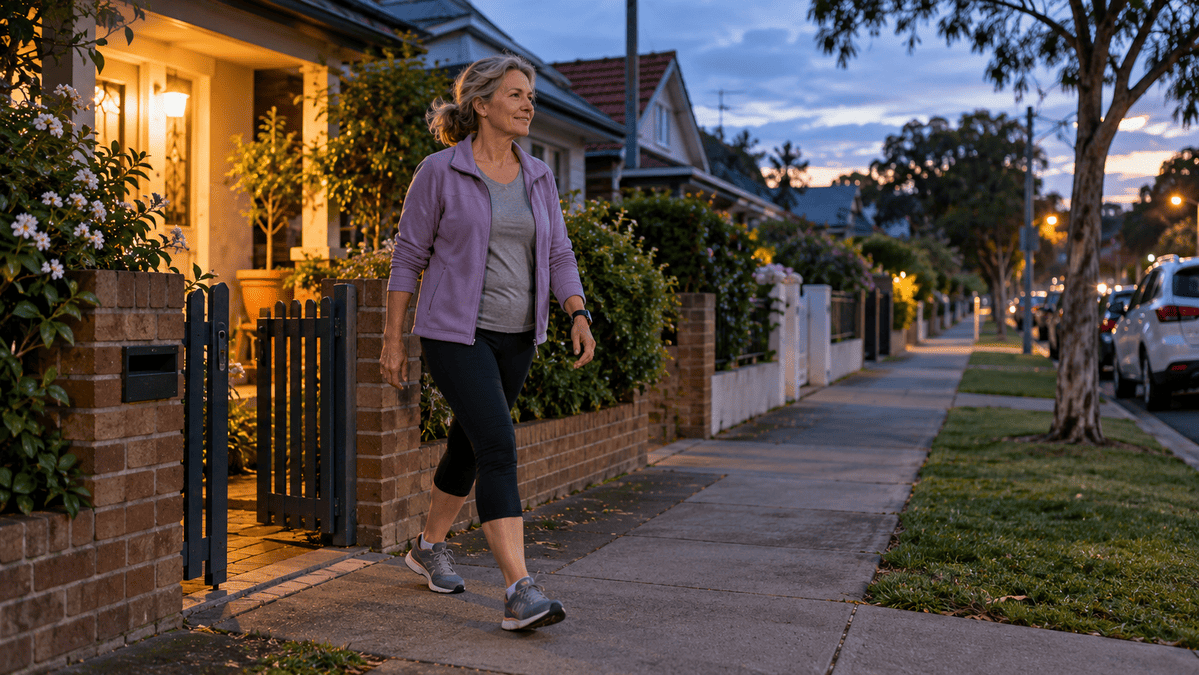
If you are walking after dark, favour a familiar, well-lit route with safe crossings. If the conditions do not suit, change the setting or postpone. A sustainable routine includes sensible decisions about when to go.
Track consistency without chasing a streak
Use a diary, calendar or phone note to record three things: roughly how long you walked, how it felt and whether the time suited your day. A note such as “eight minutes, comfortable, lunchtime worked” tells you more about your next step than a step total alone.
Review the pattern once a week. Are walks happening more regularly? Is a familiar route becoming easier? Are your feet comfortable? Keep what works and change the part that repeatedly causes trouble. If mornings keep falling apart, try a different time instead of treating it as a motivation failure.
Give the routine three versions
- Usual day: your current comfortable route, linked to a dependable cue such as finishing breakfast or shutting the laptop.
- Busy day: a shorter version that is still appropriate for how you feel. A few easy minutes can keep the appointment with yourself realistic.
- Recovery day: rest or an adjusted activity when you are unwell, injured or need recovery. The short version is not an obligation to exercise through symptoms.
After a missed walk, return to the next realistic opportunity. Avoid doubling the next session to “make up” for it. If you miss a longer stretch, reassess your baseline rather than automatically resuming your longest recent walk.
What if a walking partner is much faster?
Agree on your pace and turning point before you leave. You could share the first short loop, then let them continue. Company should make it easier to repeat your walk, rather than turn every outing into a test.
You can also leave your shoes somewhere convenient, choose a route you enjoy and tell a friend when you plan to go. Use the reminder that reduces friction for you; there is no need to turn a simple walk into another complicated project.
Know when to pause and ask for advice
Exercise should involve some effort, but pain is a reason to stop. Get advice about persistent joint or muscle pain, swelling, a limp or recurring unusual fatigue. If you are returning after surgery, a significant illness or a change in a long-term condition, follow an individual plan from your health professional.[1,5]
Stop walking and get help for chest discomfort, unusual breathlessness, dizziness or feeling faint. Call triple zero (000) for severe or worsening chest pain, chest pain lasting more than ten minutes, or chest pain with symptoms such as breathlessness, nausea or a cold sweat.[2,6]
Plan the next manageable walk
Choose one familiar route, one realistic time and a shorter backup. Start with what feels manageable now, notice your response, and repeat before adding more. A walking routine becomes sustainable when it has room for ordinary weeks, changing conditions and the occasional restart.