
Development and tree retention do not always have to be opposing goals. A new home, subdivision, commercial development or infrastructure project can often proceed while valuable existing trees remain part of the finished site—but only when their needs are understood early enough.
This is where Arboricultural Impact Assessments help protect trees during development.
Rather than simply identifying which trees are present, an Arboricultural Impact Assessment considers how proposed construction could affect them. It can identify conflicts involving excavation, foundations, driveways, services, changes to ground levels and construction activity, then recommend practical measures to reduce those impacts.
For developers, property owners, architects and planners across Australia, this information can help trees become part of the design process rather than an unexpected problem discovered halfway through it.
At a Glance
An Arboricultural Impact Assessment can help protect trees by:
- Identifying trees suitable for retention
- Assessing how proposed development may affect roots and canopies
- Highlighting potential construction conflicts early
- Establishing appropriate tree protection areas
- Recommending practical protection measures
- Helping designers adjust plans where necessary
- Providing councils with professional information when assessing a development
- Considering trees on neighbouring or public land where relevant
Australian planning requirements vary between states and councils, and local controls can play an important role in determining how trees must be managed during development. For example, NSW planning guidance recognises development control plans as a mechanism councils use to regulate trees and other vegetation.
Want to see how an assessment moves from identifying a tree to actually protecting it? Keep reading.
It Starts Before the Excavator Arrives
One of the most valuable things about Arboricultural Impact Assessments is timing.
Tree protection is considerably easier when potential conflicts are identified while plans can still be changed.
Imagine a mature tree beside a proposed driveway. On a drawing, the driveway might appear comfortably separated from the trunk. Below ground, however, excavation could affect important roots.
An assessment allows the project team to consider this before construction begins.
Possible responses might include:
- Moving the driveway slightly
- Changing its construction method
- Reducing excavation depth
- Relocating underground services
- Introducing specific tree protection measures
That is generally more practical than discovering the problem when there is already an excavator, three contractors and a concrete truck waiting for someone to make a decision.
Looking Beyond the Trunk
A common mistake is to judge construction impacts simply by measuring the distance from the building to the tree trunk.
Trees are slightly less cooperative than that.
Their roots extend through surrounding soil, while branches and canopies can also interact with buildings, scaffolding, cranes and construction access.
An Arboricultural Impact Assessment typically considers the entire tree and its relationship with the proposed development.
Depending on the project and applicable requirements, this may include looking at:
- Tree species and dimensions
- Health and structural condition
- Canopy spread
- Root protection requirements
- Proposed building footprints
- Excavation and fill
- New services
- Retaining walls
- Driveways and access routes
- Construction staging
The objective is not simply to ask, “Can we keep this tree?” It is to determine whether it can realistically be retained while the development proceeds.
Tree Protection Zones and Development Design
Tree Protection Zones, commonly referred to as TPZs, are an important part of protecting retained trees on development sites.
They help define an area around a tree where construction activities may need to be carefully controlled.
The Australian Standard AS 4970-2009, Protection of trees on development sites, is widely referenced in Australian planning documentation. For example, NSW planning controls for the Western Sydney Aerotropolis require relevant tree protection planning to be informed by an arboricultural impact assessment and prepared in accordance with AS 4970-2009.
Why does this matter?
Activities within sensitive areas around trees can potentially include:
- Excavation
- Soil compaction
- Material storage
- Vehicle movements
- Trenching
- Changes in soil level
- Installation of services
An assessment can identify where these conflicts occur and recommend ways to manage them.
Pro Tip: If substantial trees are present on or immediately beside a development site, involve the arborist while the design still has some flexibility. Small changes on a drawing can sometimes prevent much larger construction problems later.
What About Trees on Neighbouring Properties?
Tree protection does not necessarily stop at the property boundary.
A neighbouring tree may have roots extending into the development site, or its canopy may extend above proposed construction areas.
That means a development can potentially affect a tree even when the trunk belongs to someone else.
Arboricultural Impact Assessments may therefore consider relevant trees on:
- Neighbouring residential properties
- Council land
- Nature strips
- Parks or public areas
Some Australian planning controls specifically contemplate protection of trees on subject sites, neighbouring sites and public land.
This can be particularly important where basements, retaining walls or other substantial excavation is proposed close to a boundary.
Quick Guide: A New Building Is Planned Near Mature Trees
Consider a typical development site where several mature trees sit close to the proposed building footprint. The owner wants to retain them where practical, but the architect needs to know how much flexibility is available.
Common Challenges
- Are all the trees realistically suitable for retention?
- Will excavation enter areas important to tree health or stability?
- Could protecting one tree force major changes to the building design?
How to Approach It
Assess the trees early
Identify their species, size, condition and retention potential before assuming every tree presents the same constraint.
Overlay trees and proposed works
Compare the proposed development with relevant tree protection areas to identify genuine conflicts.
Look for design solutions
Where impacts exist, consider altered setbacks, construction techniques or service locations rather than immediately assuming removal is necessary.
Set construction controls
Translate the assessment into practical measures that builders can understand and implement on site.
Why It Works
This approach turns tree protection from a vague planning objective into a set of identifiable design and construction considerations.
It can also help the project team distinguish between manageable impacts and situations where a proposed design creates a genuine conflict.
Protection Does Not End When Plans Are Approved
A good assessment can inform planning, but trees still need protection during construction.
Recommendations may include measures such as:
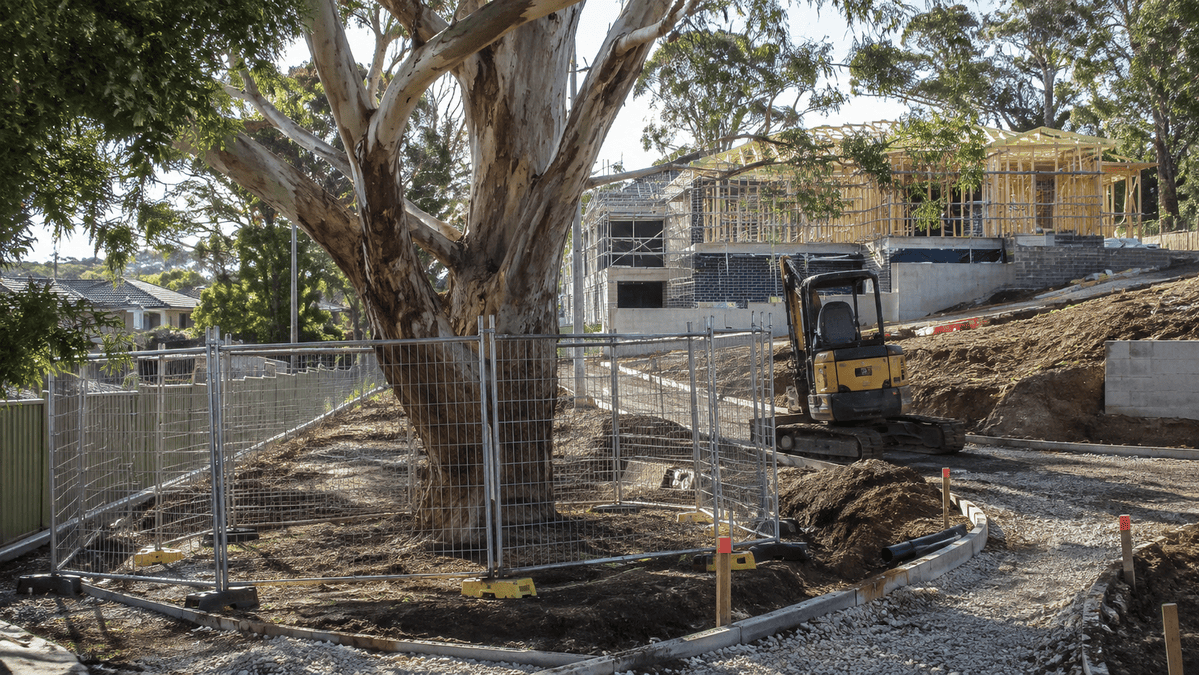
- Protective fencing
- Restrictions on excavation
- Controlled access near retained trees
- Appropriate methods for installing services
- Arborist supervision for particular works
- Canopy protection
- Restrictions on storing materials around trees
- Monitoring during key construction stages
A tree protection plan can address different stages of development because risks may change as construction progresses. This staged approach is reflected in current NSW planning documentation for major development areas.
In simple terms, drawing a circle around a tree on a plan is useful—but making sure nobody parks a two-tonne excavator inside that circle is even more useful.
Why Early Assessment Can Produce Better Development Outcomes
An Arboricultural Impact Assessment is not only about protecting individual trees. It can also help inform the broader design.
Early information allows architects, engineers and planners to understand which trees represent significant constraints and which conflicts may be manageable.
This can support decisions about:
- Building positioning
- Basement footprints
- Vehicle access
- Landscaping
- Stormwater infrastructure
- Utility routes
- Construction methodology
When the assessment happens late, the same information may instead result in redesign.
Early arboricultural input provides options. Late arboricultural input often provides problems that now need fixing.
Quick Quiz: Is Tree Protection Likely to Influence Your Project?
Answer Yes or No.
1. Are mature trees located close to proposed buildings or excavation?
2. Does the site contain trees you want or may be required to retain?
3. Are there large neighbouring trees close to the boundary?
4. Will the project include basements, retaining walls or extensive trenching?
5. Could construction vehicles or material storage occur close to trees?
Your Result
0–1 Yes: Tree impacts may be limited, although local planning requirements should still be checked.
2–3 Yes: Arboricultural constraints are worth investigating during design.
4–5 Yes: Early Arboricultural Impact Assessments could play an important role in planning the development and protecting retained trees.
Frequently Asked Questions
Does an Arboricultural Impact Assessment mean every tree must be retained?
No. The assessment considers the condition, value and likely development impacts associated with relevant trees.
It may recommend retention for some trees while identifying others as unsuitable or less appropriate for retention. The relevant approval authority ultimately determines what is permitted under applicable planning controls.
When should the assessment be prepared?
Ideally, before the development design becomes difficult or expensive to change.
For sites with substantial trees, early arboricultural input can help designers understand constraints rather than responding to them after plans are effectively complete.
Can construction occur inside a Tree Protection Zone?
Potential encroachment does not automatically tell you whether a project can or cannot proceed.
The circumstances need to be professionally assessed. The location, extent and nature of works can matter, along with the characteristics of the particular tree.
Are Arboricultural Impact Assessments required everywhere in Australia?
No. Requirements differ between councils, planning schemes and projects.
Local planning controls should therefore be checked rather than assuming that requirements in one council area apply elsewhere. Australian Standards themselves are generally voluntary unless incorporated into legislation, regulation, contracts or other requirements.
Is an Arboricultural Impact Assessment the same as a basic tree inspection?
Not necessarily.
A tree inspection may primarily examine the tree itself. An Arboricultural Impact Assessment specifically considers the relationship between trees and proposed development, making the development plans a central part of the assessment.
Conclusion
Arboricultural Impact Assessments help protect trees by bringing arboricultural considerations into development planning before construction creates irreversible impacts. They identify trees suitable for retention, examine potential conflicts with proposed works and provide practical recommendations for protecting roots, trunks and canopies throughout the project.
For Australian property owners and developers, their greatest value is often early information. Understanding tree constraints while plans remain flexible can support better design decisions, clearer development applications and more practical construction management.
When significant trees are located on or near a development site, assessing their relationship with the proposed works early can benefit both the project and the trees intended to remain.